

Movement,
measured at
the source
TracME combines patented soft-sensor textiles with real-time AI to turn your body's physics into actionable coaching. No cameras. No guesswork. Just data.
TracSil™ —
soft flexible sensor
Most fitness wearables measure acceleration from the wrist — a proxy that loses precision the moment you stop moving in a straight line. TracSil™ is embedded directly in the sleeve, capturing your body's movement signals in real time.

Stretchable Silicone
Flexes with every joint movement — no rigid components, no discomfort.
Precise Motion Sensing
Sensor sits close to the body's movement source — not at your wrist.
No Camera Required
Full tracking with zero video — private, portable, setup-free.
Washable Textile
Built into the sleeve fabric — durable enough for daily training.
Coaching that reacts
while you move
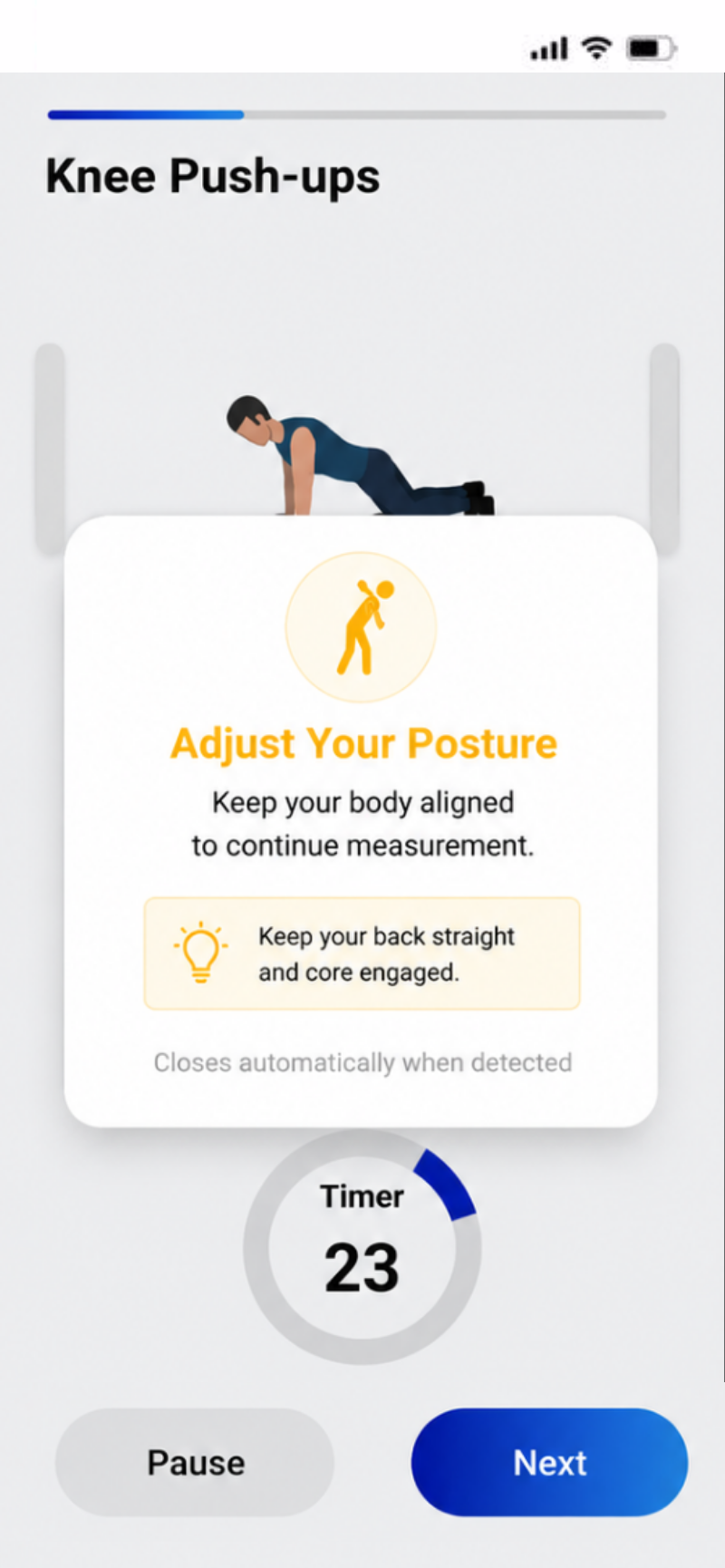
Because TracSil™ streams joint data continuously, the app doesn't wait until your workout is over to tell you what happened. It watches every rep as it happens — and speaks up the moment something needs fixing.
Instant posture alerts
Drift out of alignment mid-set and the app pauses to guide you back — like the "Adjust Your Posture" prompt shown here.
Only clean reps count
Reps are counted from measured range of motion — half-reps and sloppy form don't inflate your numbers.
Left–right balance, live
Both limbs are measured simultaneously, so imbalances show up during the set — not in a report days later.
Tested on real bodies,
not just in the lab
Every sensor reading is only as good as the data behind it. TracME's Data Lab program takes measurement into the field — sports events, universities, clinics — where each participant is individually calibrated against physical angle references.
Different body types, muscle mass, and limb lengths all shift what a sensor sees. Measuring across hundreds of real people is what turns raw signals into trustworthy joint angles.
How TracME is grounded
in accurate data
Most AI answers from general patterns. TracME's coaching starts from something better: the joint angles and reps your sensors actually measured.
RAG stands for Retrieval-Augmented Generation. Before the AI generates any feedback, it retrieves your real sensor data — every rep, every range of motion captured by TracSil™. The AI is grounded in your measurements, not general patterns. That's why TracME's coaching feels specific, not generic.
TracME vs. other approaches
Not all movement tracking is equal. The method of data collection fundamentally determines what's measurable — and what's just a guess.
| Feature | TracME | Smartwatch / Wristband | Camera-Based Tracking |
|---|---|---|---|
| Data Source | Direct body sensor (TracSil™) | Wrist accelerometer (indirect) | Visual pose estimation (indirect) |
| Motion Accuracy | ✓ High precision | ✗ Limited accuracy | ~ Depends on setup & lighting |
| Real-Time Form Feedback | ✓ Per-rep, instant | ✗ Not available | ~ Requires good lighting & angle |
| Left-Right Imbalance Detection | ✓ Both limbs simultaneously | ✗ Single wrist only | ~ Possible but unstable |
| Camera / Setup Required | ✓ None | ✓ None | ✗ Yes — positioning critical |
| Works for Stationary Exercises | ✓ Optimized for it | ✗ Limited (no GPS movement) | ~ Yes, with setup |
| Privacy | ✓ No video, no images | ✓ No video | ✗ Video recording required |
| AI Coaching | ✓ Grounded in sensor data (RAG) | ~ Generic recommendations | ~ Varies by platform |
Where TracME fits
Precise motion data opens up applications well beyond consumer fitness.
Personal Fitness
Real-time form correction and AI coaching for independent training — without a trainer present. Works for strength, mobility, and rehab exercises at home or in the gym.
Clinical & Rehabilitation
Quantifiable range-of-motion data per session. Track movement and recovery progress over time with objective, sensor-based measurements — not self-report or visual estimation.
Research & Data Collection
Field-deployable motion tracking at scale. TracME's Data Lab program collects validated movement datasets at sports events, universities, and clinical settings worldwide.
Stay ahead of
what's next.
Get updates on TracME technology, data accuracy improvements, and new applications as we build.
Get Early Access →No spam. Unsubscribe anytime.